· SoilSense team
Soil Acidity Meter vs pH Test Kit vs Lab Test
You are standing over a bed wondering whether the soil is too acidic for what you want to plant. Three instruments claim to answer that, and they do not deserve equal trust. We sell one of them, so here is the part most product pages leave out.
Soil acidity meter vs pH test kit vs lab test: what each actually measures
| Tool | What it responds to | What you get back |
|---|---|---|
| Analog acidity meter | Current through moist soil | A needle between 8 (alkaline) and 3.5 (acidic) |
| Chemical kit or strip | A dye that changes colour with the acidity of the sample | A colour to match against a printed chart |
| Mail-in lab test | A calibrated electrode in a prepared slurry | A pH figure, nutrient levels, and how much lime or sulfur to apply |
Only the second and third react to acidity itself. That one difference explains everything that follows.
Why the acidity row on a dial is a direction, not a number
Our meter is passive. There is no battery and no glass electrode inside it, and a glass electrode paired with a reference is what a genuine pH instrument uses. What the probe has instead is metal in contact with damp soil, generating the small current the needle rides on. Acidity influences that current. So does how wet the soil is, how much fertiliser salt sits in it, and how firmly the metal touches the grains. The needle cannot separate those inputs, which is why the printed scale stops at whole marks and why we call the reading directional on the pH meter page and in our method notes. A dial like this cannot honestly give you a decimal.
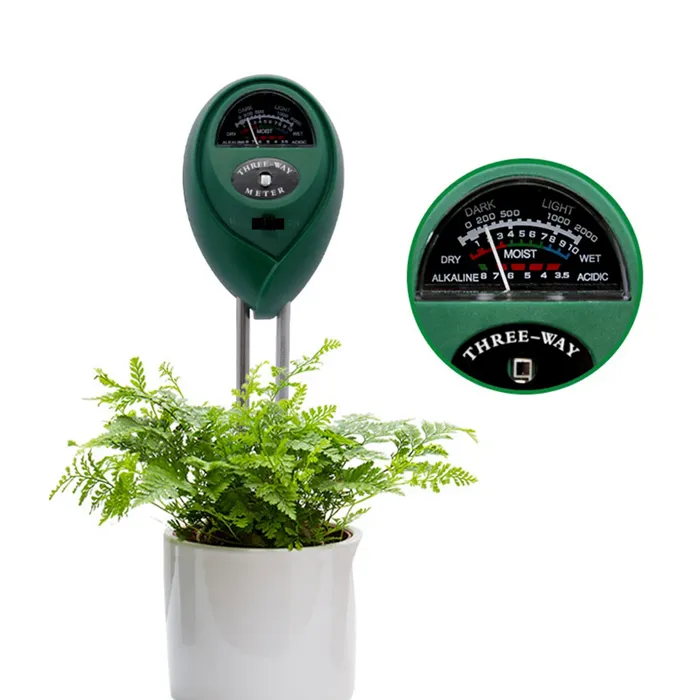
What moves the needle besides acidity
Read the same pot twice under different conditions and you will often land on two different marks. The usual culprits:
- Recent watering. Wetter soil conducts more, and the acidity row rides the same circuit as the moisture row.
- Liquid feed. Fertiliser salts conduct strongly and push the needle for reasons unrelated to acidity.
- Poor contact. Chunky or half-dry mix leaves air gaps around the metal and the needle sits lazily near the middle.
- Soil type. Sand and heavy clay behave differently at the same acidity, so readings are not comparable across beds.
pH test kit vs soil acidity meter: where the colour match kit wins
A capsule or strip kit works on the chemistry you are actually asking about. You mix a soil sample with water, add the indicator, and match the colour against a chart. Two things make that more trustworthy than a dial: the colour is produced by the acidity rather than by conductivity, and a botched sample usually looks obviously wrong instead of quietly plausible. The trade-offs are real, since it is single use, messy, and colour matching in a dim shed adds its own error. Before you commit a season to a blueberry bed, this is the cheapest answer. Our guide on testing soil pH at home covers the sampling steps.
When a mail-in lab test is worth the wait
A local extension service or private lab runs a calibrated electrode on a properly prepared sample and sends back nutrient levels alongside the pH figure. The line that matters most is the last one: how much lime or sulfur to apply per area, for your soil. Neither a dial nor a colour chart can produce that, because the dose depends on how strongly your soil resists change, not on today's reading. It costs money and takes weeks. Worth it before you build a permanent bed or plant a fruit crop. Not worth it for a windowsill pothos.
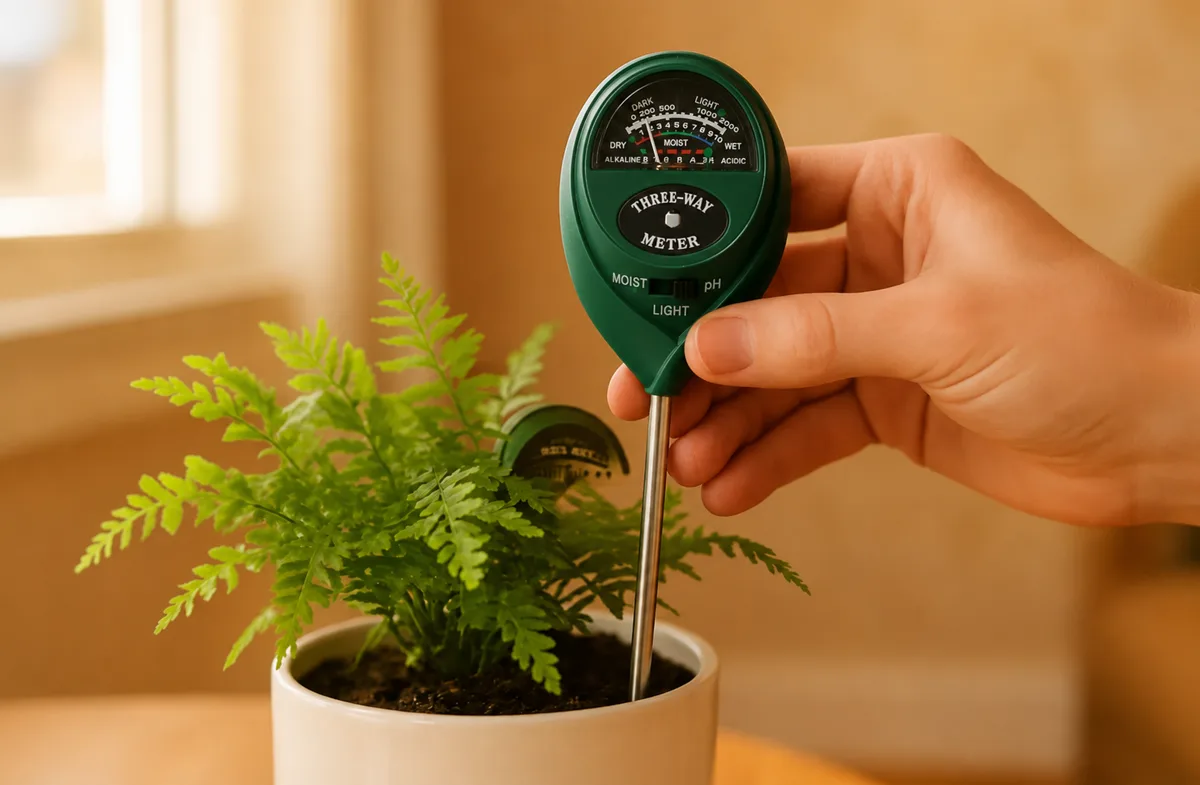
What each reading actually lets you decide
| The decision in front of you | Reading you can act on |
|---|---|
| Is this bed leaning acid or alkaline at all? | Probe is enough |
| Do I commit this corner to blueberries? | Chemical kit |
| How much lime do I spread, and when? | Lab test |
| Did last year's sulfur change anything? | Chemical kit, same method both times |
| This pot has stalled and the soil looks fine | Probe, moisture mode first |
That last row is the case for owning a probe. Acidity is a once-or-twice-a-season question; watering is a weekly one, and it is the one that a cheap probe handles well. One buyer put the split plainly: "Bought it mostly for the pH mode before starting a raised bed. Simple to read, no fiddly chemicals. Moisture and light are a nice bonus."
Frequently asked questions
Can a soil acidity meter be calibrated?
No. A passive probe has no buffer solutions and no adjustment screw, so there is nothing to calibrate. If it returns the same value in soils you know are different, the unit is faulty and our 30-day money-back guarantee covers it.
Why does my meter read close to neutral in every pot?
Usually poor contact: loose mix, a probe pushed in only an inch, or a dry surface layer. It is also genuinely possible that your bagged mixes really are near neutral, because most are blended that way.
Are pH strips better than the acidity mode on a probe?
For the acidity question, yes. A strip reacts to the chemistry you are asking about, while a needle responds to current flowing through wet soil. Strips are still rougher than a capsule kit or a lab test, and they are single use.
Free shipping, delivered in 6 to 10 business days · 30-day money-back guarantee