· SoilSense team
How to Clean a Soil Moisture Meter Probe
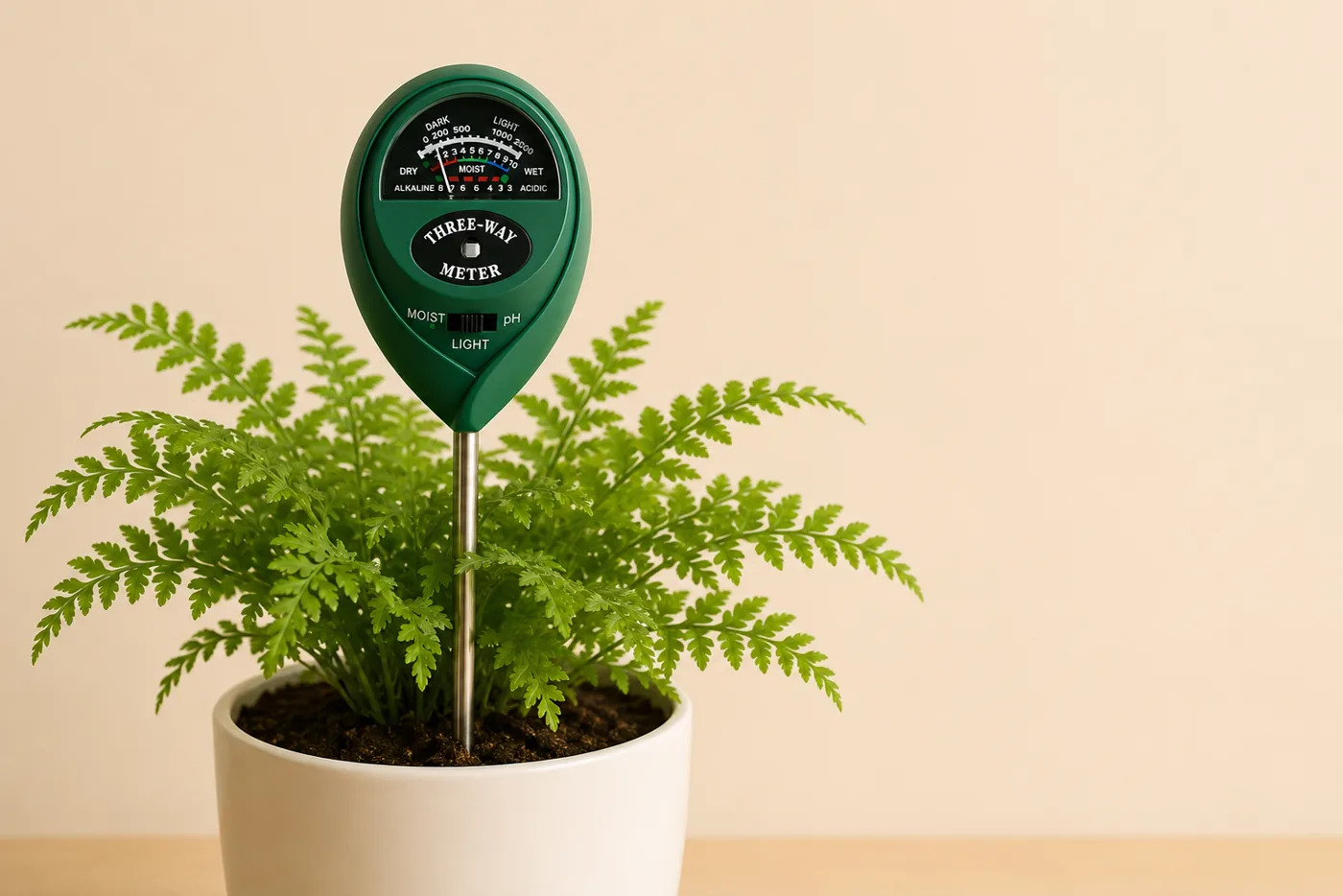
Everything a passive meter tells you passes through the surface of its metal probe. There is no sensor buried in the shaft and no software correcting anything downstream — the metal touches damp soil, and that contact is the whole instrument. So the thin layer of whatever you last left to dry on it is not dirt on a tool. It is sitting inside the measurement. Cleaning the probe is not housekeeping; it is what keeps a reading worth acting on.
What ends up on the probe, and what it does
Pull a probe out of a pot and look at it in good light. You will usually find three things at once. First, soil: fine particles pressed into the grain of the metal, drying into a matte skin you can scratch off with a fingernail. Second, mineral scale — the chalky bloom that forms in a kettle, left wherever tap water evaporated off the shaft. Third, the tarnish of the metal itself, a slow dulling that comes from spending time wet and then drying in air.
All three do the same thing: they put a layer between the metal and the soil. Because these meters work on the small current that flows through moist soil, a probe wearing a coat is reading the coat as much as the pot. The effect is neither dramatic nor sudden, which is exactly why it catches people out. The reading still looks perfectly plausible. It has simply stopped being comparable to the readings you took when the metal was bare.
The habit that prevents nearly all of it
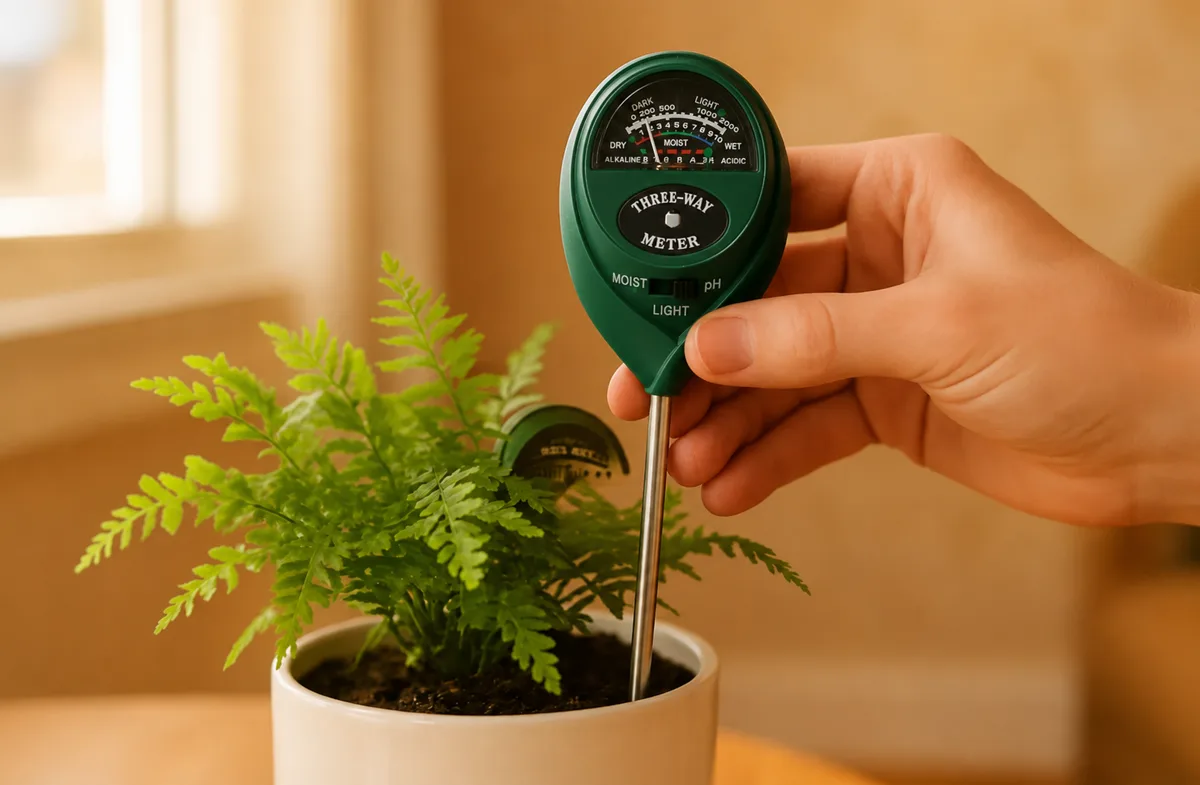
The whole of probe care is one movement, done at the right moment: wipe the metal dry as you withdraw it, while the soil on it is still damp. Damp soil comes away with a cloth and leaves nothing. The same soil, left to dry for an hour, has to be softened again before it will move, and that is when people start scrubbing at metal they should not be scrubbing.
Keep a cloth wherever the meter lives so the wipe is not a separate trip. Run it along the shaft from shoulder to tip, turn it, run it again, and pay attention to the tip, which pushes through the most soil and collects the most. Working through several pots in one session, wipe between each — a probe carrying moist soil out of one pot and into the next gives you a first reading that belongs to the wrong plant.
Then let it finish drying in open air before it goes away. Not left in the pot, which dulls a probe faster than anything else, and not straight into a closed drawer with a film of moisture still on it. The rest of the routine — probe two-thirds of the way toward the root ball, a full minute for the needle to settle — is covered in our guide to reading the dial for each plant type.
Bringing back a probe that has already dulled
If the wipe was skipped for a season, the layer is already hard and dry, and the order of operations matters. Soften first, lift second, polish third, dry last.
Soften by wrapping the shaft in a damp cloth and leaving it long enough for the crust to take up water and let go. Do not go at hardened soil dry: dry grit dragged along steel is abrasive, and every pass leaves fine scratches that hold the next lot of soil more stubbornly than smooth metal did. Once softened, lift the crust away with the cloth rather than digging at it. Mineral scale, which resists plain water, gives up to a cloth dampened with household vinegar — the same vinegar as in the kitchen test in our guide to testing soil pH at home — because scale is alkaline and vinegar is not.
Polishing is the step that actually restores the reading. What you want at the end is metal with its own shine back, uniform from shoulder to tip, no dull patch where the film held on longest. A fine kitchen scouring pad or very fine abrasive paper does this quickly, worked along the shaft rather than around it, with light pressure. Then dry it completely: a probe polished back to bare metal and put away damp starts dulling again immediately.
What never to do to the metal
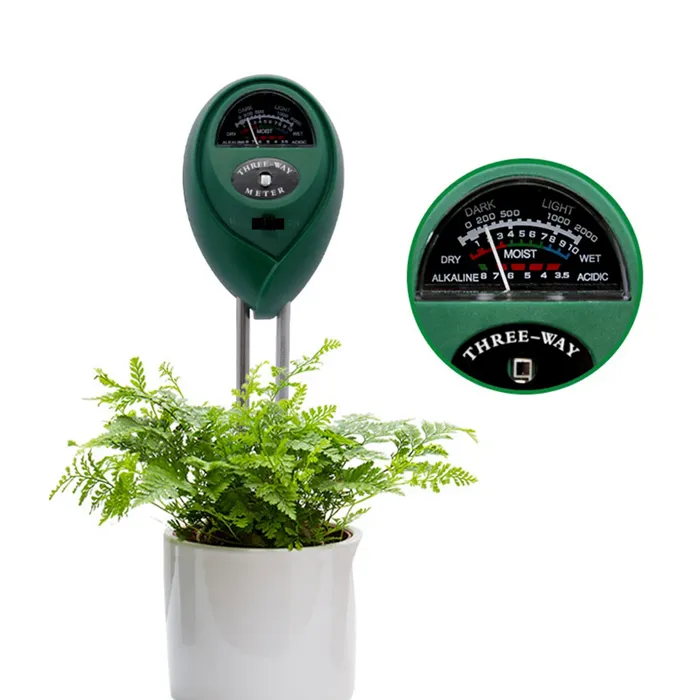
Never put the head under water. The dial and the needle movement behind it are not sealed against a tap. Water that finds its way in does not evaporate back out, and a needle that has been wetted stops swinging cleanly. The rule is that the cloth travels to the meter, not the meter to the sink.
Never leave the probe buried between readings. A meter parked in a pot as a permanent gauge spends every hour of every day wet, which is the condition that dulls bare metal fastest. Read, withdraw, wipe, store.
Never scrub hard enough to score the metal. Deep scratches are not cosmetic here: they increase the surface that holds residue and give the next film somewhere to key into, so an aggressively cleaned probe gets dirty faster than a gently cleaned one.
Never use bleach or a caustic drain product. They attack the metal rather than the deposit, and they leave their own residue behind on a surface whose whole job is to be nothing but itself.
Never use the probe to break up compacted soil. Pushing it through a set crust, or levering it against a dense root ball, bends the shaft and scores the metal in the same movement. If the surface has hardened, open it with something built for the job and insert the probe into the opening.
Feed, hard water and outdoor beds leave different marks
Three situations put more on the probe than ordinary indoor potting mix, and each wants a slightly different response.
After liquid feed. Fertiliser is salt in solution, and salt is the most conductive thing your probe will meet. What dries on the metal after probing a freshly fed pot stays conductive, so this is the residue that most deserves the immediate wipe. It is also, as our comparison of acidity meters and pH test kits explains, why a needle climbs for reasons unrelated to the question you asked.
Hard tap water. If your kettle furs up, your probe will too. The bloom builds slowly and evenly, which makes it the easiest deposit to miss and a good reason to look at the shaft properly every so often rather than only when something seems wrong.
Outdoor beds. Garden soil is grittier than bagged mix, and heavy clay packs into the grain of the metal in a way potting compost does not. Sand caught on the shaft also travels with you from spot to spot. A wipe between each of the three readings keeps them genuinely independent.
Where the meter should live between readings
Store it dry, out of sunlight, and where the probe cannot be bent. A bent shaft stops you inserting to the same depth in the same way, and depth consistency is what makes two readings comparable at all. The drawer where it lies flat under other things is worse than the hook where it hangs free.
Somewhere near the plants beats somewhere tidy. A meter kept in the room you water in gets used before you water; one kept in the garage gets remembered afterwards. Build and probe are among the first criteria in our method notes, precisely because a tool that is awkward to keep to hand stops being consulted.
The one moment worth a deliberate look is the start of a season, when the meter comes back into daily use after months of sitting. Turn the shaft in good light before the first round of readings rather than after. Anything that settled on it over the quiet months is easiest to remove before it has been pushed into another pot, and it puts the readings you start the season with on the same footing as the ones you ended the last one on.
Telling a tired probe from difficult soil
When a reading looks wrong, the probe is one candidate among several, and there is a quick way to sort it out. Take the reading you doubt. Then clean and polish the shaft properly and take it again in the same spot, at the same depth, giving the needle its full minute both times. If the second reading has moved, the layer on the metal was the problem and it is now solved. If it lands in the same place, the probe is telling the truth and the answer is in the pot.
That second case is worth knowing how to read. A needle sitting close to the middle everywhere, in pots you know are different, usually means poor contact rather than identical soil — chunky bark mix and half-dry compost both leave air around the metal. A needle that stays high in one pot for days after the others have come down is usually drainage. And one that will not move in soil you have just watered points at the condition these probes are not built for: they need damp soil in the circuit, never plain water or neat fertiliser. What a clean probe settles, and what belongs to the pot instead, is covered in our guide to what a probe reading tells you.
A little care, then, buys the thing that makes the whole tool work: a reading today that means what a reading last month meant. It keeps the acidity row on the pH side of the dial usable too, since that rides the same current through the same metal, and it is why the probe is the part of a 3-in-1 meter worth your attention every time you use it.
Frequently asked questions
Can I rinse the whole meter under the tap?
No. Only the metal probe should ever meet water, and only briefly. The head holds the needle movement behind the dial, and water that gets in there does not come back out. Dampen a cloth and bring the cloth to the metal rather than taking the meter to the sink.
My probe has dark patches that will not polish out. Is it finished?
Almost certainly not. What the reading depends on is bare, smooth, continuous metal in contact with damp soil. A shadow in the grain of the steel that stays after polishing is cosmetic. Pitting you can feel with a fingernail is the one to act on, and a unit that reads the same in soils you know are different is covered by our 30-day money-back guarantee.
Does cleaning the probe change the readings I already wrote down?
It can nudge them, and in the right direction. A probe that had been drifting under a layer of dried film will read a little differently once the metal is bare again. If you keep a "just watered" mark for a particular pot, take it once more after a thorough clean so both ends of your scale come from the same clean surface.
Free shipping, delivered in 6 to 10 business days · 30-day money-back guarantee