· SoilSense team
Soil Moisture Chart: What the Numbers Mean, Plant by Plant
Take a reading and you hold a number. The number is the easy part. What fills search boxes and plant forums is the step after it: is 4 fine, is 20% bad, what should it be? This guide is about that step: what each figure means, family by family, and how percentages quoted elsewhere translate onto the dial in your hand.
One wetness, two languages
Every number you will ever meet on this subject comes from one of two instruments, and they do not speak the same language. Farm and greenhouse sensors report volumetric water content: the share of a soil's volume that is currently water, written as a percentage. It is the language of irrigation controllers and research plots, and it comes with a catch we will get to shortly — the same percentage describes a different situation in every different soil.
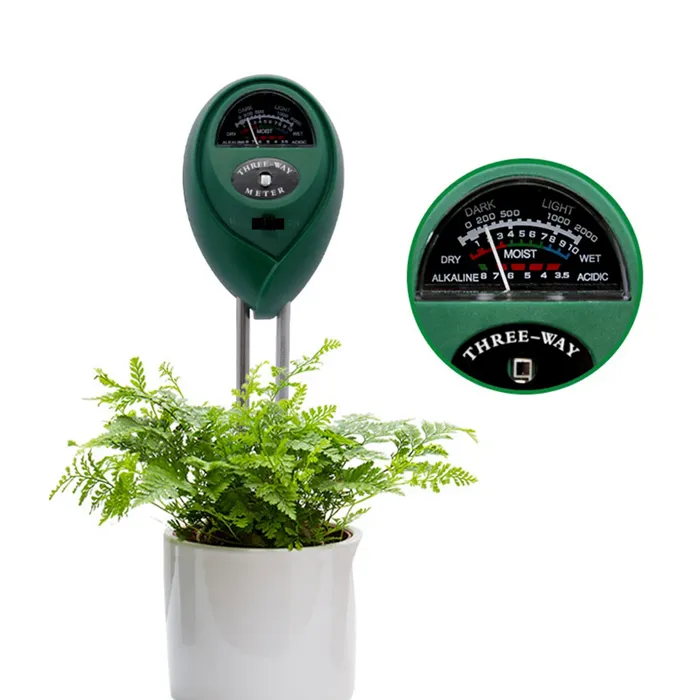
The SoilSense 3-in-1 speaks the second language. Its moisture row runs from 1 to 10, grouped into three printed regions — dry, moist, wet — and the needle answers a simpler, sharper question: where does this soil sit, right now, between its own bone dry and its own soaked? That is a relative scale, and relative is precisely what a watering decision needs. You are never asked to know your potting mix's laboratory profile. You watch one pot travel down its own scale and act when it reaches the band its plant likes.
The two languages meet in the thirds. The bottom third of the dial is the territory a percentage probe would call approaching wilting point; the middle third is the comfortable, plant-available zone; the top third is the just-watered or poorly-drained zone. Hold that mapping and every number in the rest of this guide has a home.
The chart: the right band, family by family
Plants do not want a number; they want a zone, held loosely. The chart below gives the band each family likes to live in and the reading that means it is time to act. The right-hand column deliberately matches the triggers in our guide to when to water with a moisture meter — that article owns the movement itself, how deep to probe, how long to wait, how much to pour. This one owns what the needle is telling you in the meantime.
| Plant family | Happy band | In words | Act at |
|---|---|---|---|
| Succulents & cacti | 1–3 | Dry, with brief wet spells | 1–2 |
| Most houseplants (pothos, monstera) | 3–6 | Drying out between drinks | 3–4 |
| Tropicals & calatheas | 4–7 | Slightly moist at all times | 4–5 |
| Ferns & seedlings | 5–7 | Evenly moist, never parched | 5–6 |
| Woody herbs (rosemary, thyme, sage) | 2–5 | Lean and on the dry side | 2–3 |
| Leafy herbs (basil, parsley, mint) | 4–6 | Steadily moist | 3–4 |
| Vegetable beds | 4–7 | Evenly moist at depth | 3–4, averaged over three spots |
| Lawns | 3–7 | Swinging between deep soaks | 3–4 on the average |
Two reading habits make the chart work. Outdoors, never trust a single spot: moisture varies across a bed, so probe three places and average. And everywhere, judge only the root zone — a bed can crust bone dry on top while sitting comfortably moist where the roots are, which is why the surface fools the eye and the probe does not.
What should your soil moisture percentage be?
There is no single correct percentage, and the reason is the soil itself. USDA soil-health primers describe an ideal loam as roughly half solid particles and half pore space, with the pores sharing water and air. After a soaking, gravity pulls the surplus down and the soil settles at what soil scientists call field capacity — as much water as it can hold against gravity. Below that, roots keep drawing until the remaining water clings to the particles too tightly to extract: the wilting point. The percentages at those two marks swing widely with texture. A sandy mix drains to a low figure and still feels moist to a root; a heavy clay can hold a high figure and yet have little a root can actually use.
What a grower manages is the space between those two marks — the plant-available water. USDA irrigation guidance runs on exactly that logic: refill before the plant has drawn down about half of what is available to it, rather than waiting for the soil to run empty. On the dial, that thinking is already done for you. The middle third is the plant-available comfort zone, the trigger numbers in the chart are the refill points, and no percentage table for your particular mix is required. We describe how we arrive at bands like these in our method notes.
Is 20% moisture bad?
On its own, 20% is not good or bad — it is incomplete. On a volumetric sensor, 20% in a sandy mix sits near the top of what that soil can hold once gravity has finished with it: wet, in effect, and time to hold off. The same 20% in a heavy clay sits near the bottom of what roots can extract: dry, in effect, and close to watering time for anything but drought lovers. In a loamy garden bed, 20% lands in the comfortable middle. One figure, three verdicts, and the difference is entirely the soil it came from.
If what you actually saw was a 2 on a 1–10 dial, the reading is far easier to judge, because the dial has already folded the soil into the answer. A 2 is the dry end of this pot's own range: resting territory for a succulent, action stations for a monstera, and overdue for a fern. That is the quiet advantage of a relative scale — it trades laboratory units for a verdict you can act on in the pot in front of you, and it stays comparable from one week to the next. What a probe reading can and cannot tell you is a subject of its own, covered in what a probe reading tells you.
What counts as a normal — and an acceptable — reading?
Normal is not a number; it is a rhythm. A healthy pot cycles: it reads high in the day or two after watering, slides through the middle of the scale as the plant drinks and the pot breathes, touches its trigger, and gets watered back to the top. Every reading along that path is normal. The 8 on Tuesday and the 3 the following Friday are the same healthy pot at two points of one cycle, which is why a single reading, taken once and judged in isolation, says so much less than three readings a few days apart.
Acceptable, then, means two things at once: the number sits inside the band for that plant family, and it is moving the way the cycle says it should. Judge it only at root depth, with the probe two-thirds of the way in, at the same depth each time — consistency of depth is what makes two readings comparable at all. And keep the rows straight: the acidity row on the same instrument runs on a different scale for a different question, which is the territory of the pH side of the dial, not this chart.
What moisture level is too high?
The top third of the dial is not alarming in itself — a pot you watered this morning is supposed to read 8 or 9, and a vegetable bed after real rain will pin the needle for a day. Too high is not a level; it is a level that will not leave. A pot that sits at 8–10 for days, long after its neighbours have come back down, has stopped cycling, and soil that never leaves the wet zone is soil whose pores hold water where air should be. Roots do not drown the way we picture it; they suffocate slowly, and by the time leaves yellow, the meter has been reporting the problem for a week.
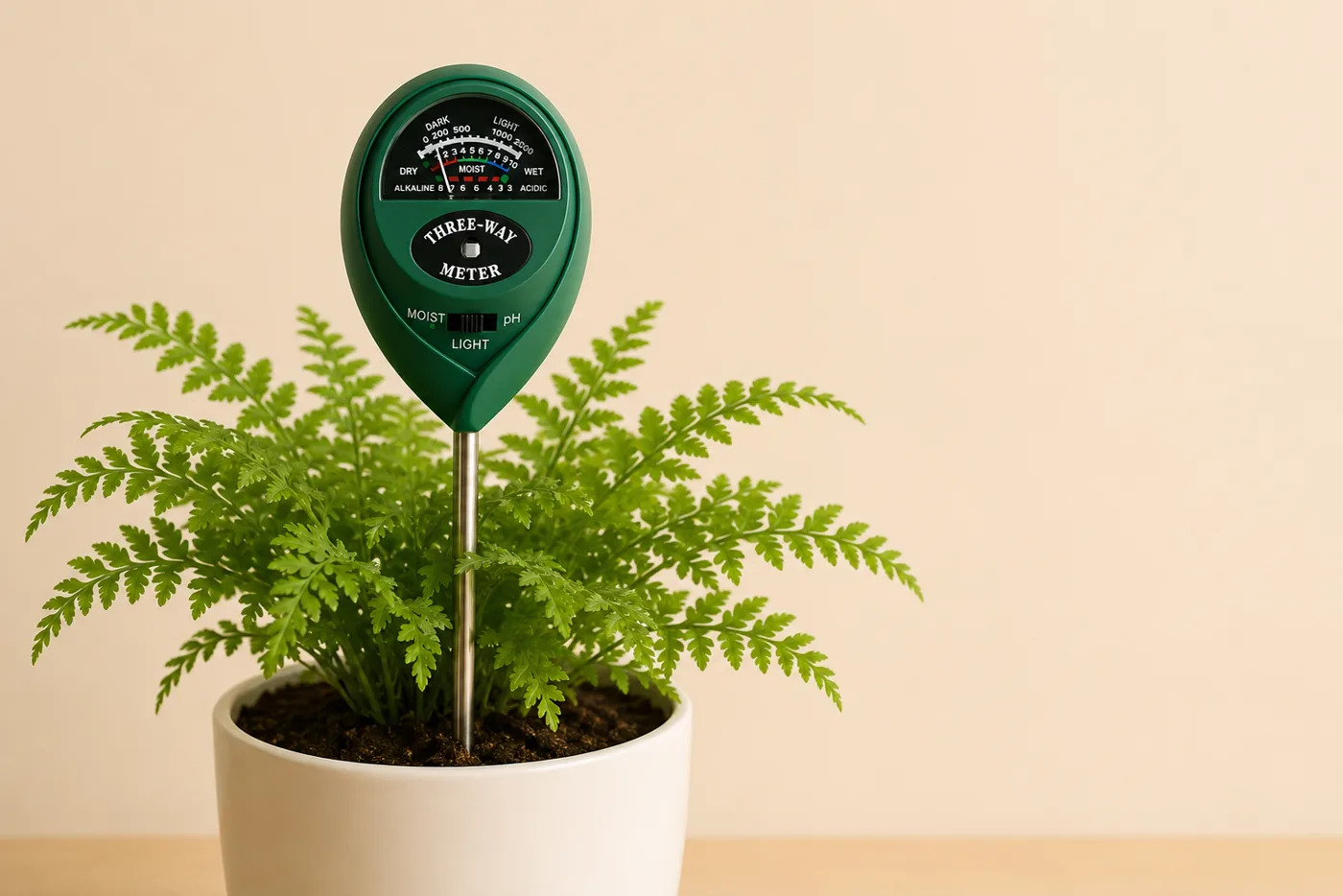
A stuck-high reading is therefore an instruction to investigate, not to wait politely. Check that the pot drains at all, and that the drainage hole is not sealed by a saucer of standing water. Ask whether the pot is oversized for the plant — a small root system in a big volume of mix cannot drink the pot down. And remember the season: in low-light winter months a plant may take three times as long to travel down the same scale, which is not a fault in the plant or the meter, just a slower cycle.
What a genuinely bad reading looks like
Ask what a bad moisture reading is and most people mean a low number, but a low number in the right band is just a succulent at rest. The genuinely bad readings are the ones that stop carrying information. A needle pinned high in one pot for days while the others cycle points at drainage. A needle that lands mid-scale in every pot, in soils you know are different, points at poor contact between metal and mix — chunky bark blends leave air around the probe. A needle that barely moves in soil you have just watered points at a film on the metal doing the reading in the soil's place, which is solved in ten minutes with a proper probe clean.
In other words: judge a suspicious number the way you would judge a suspicious silence — by checking what stands between the instrument and the soil, then reading again in the same spot at the same depth. The number that comes back from clean metal, at root depth, inside a cycle you have watched for a week, is one you can act on with real confidence.
And once it says today is the day, the remaining questions are the old familiar ones: how to pour is in the reading-the-dial guide, and the hour that loses the least of it to evaporation is in the best time of day to water plants.
Frequently asked questions
Do the 1–10 dial and a percentage sensor line up point for point?
No, and they are not meant to. A percentage sensor reports how much of the soil volume is water, a figure that shifts with soil texture. The dial reports where this soil sits between its own dry and wet, which is the comparison a watering decision actually uses. The thirds of the dial and the working range of a percentage probe correspond in spirit — dry, moist, wet — not number for number.
My meter reads 9 right after watering. Did I overdo it?
No. A pot you have just watered properly is supposed to read at the top of the scale — that is what a full drink looks like. The question is what happens next. A healthy pot slides back down through the middle of the dial over the following days. A pot that is still sitting at 8–10 several days later is asking you to look at its drainage, not at your pouring.
Should every pot in the house sit at the same number?
No, and if they ever did, that would itself be a signal to check the probe rather than a sign of harmony. A succulent resting at 2, a monstera passing through 5 and a fern held at 6 are all exactly where they belong. Each family has its own band, and the reading is only ever judged against the band of the plant in front of you.
Free shipping, delivered in 6 to 10 business days · 30-day money-back guarantee